Pet Laparoscopic Procedures
At Falmouth Veterinary Hospital, we know your close relationship with your precious family members.
Pet Laparoscopic Procedures
When you choose Falmouth Veterinary Hospital for your pet’s laparoscopic treatments, you select a group of caring professionals who share your love and commitment for your beloved family member. Give your pet the gift of less invasive treatment, a quicker recovery, and comfort.
Call us now to arrange a consultation and learn how laparoscopic operations can significantly improve your pet’s quality of life. Join us to ensure your beloved pet has health, happiness, and energy.
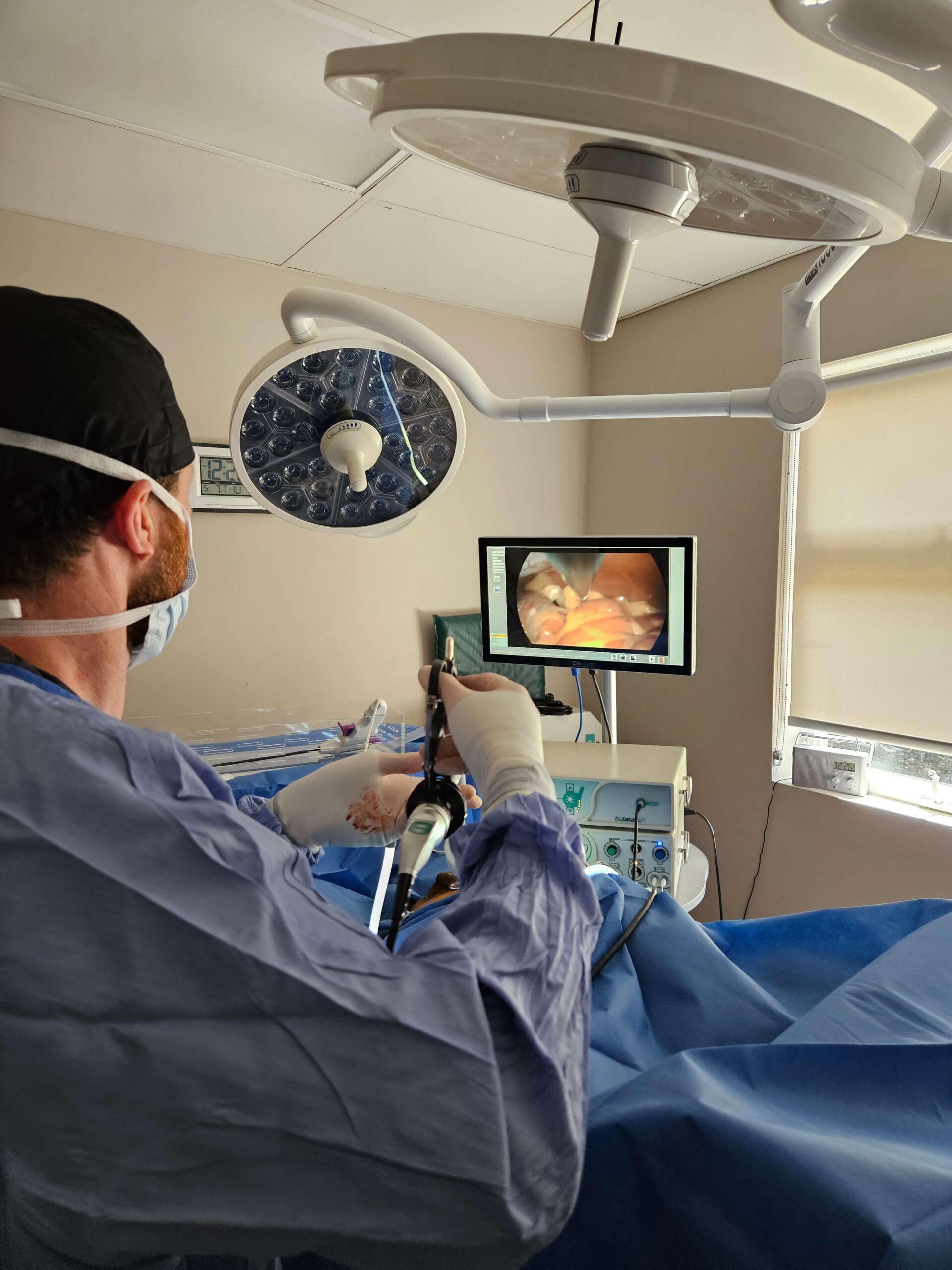
We offer advanced laparoscopic (keyhole) surgery, allowing many abdominal procedures to be performed through very small incisions using a high-definition camera and specialized instruments.
This approach reduces surgical trauma and improves recovery—meaning your pet experiences less pain, smaller incisions, and a faster return to normal activity compared to traditional open surgery.
What is Laparoscopic Surgery?
Laparoscopic surgery uses a small camera (laparoscope) inserted into the abdomen to provide magnified, high-definition visualization of internal organs. Surgical instruments are introduced through small ports, allowing procedures to be performed with minimal disruption to surrounding tissues.

Procedures Offered
Laparoscopic Spay (Ovariohysterectomy)
- Significantly reduced postoperative pain
- Smaller incision
- Faster return to normal activity
- Reduced tissue trauma compared to open surgery
Laparoscopic-Assisted Cryptorchidectomy
- The laparoscope allows precise localization
- The testicle is then removed through a small incision for safe extraction
- Avoids large exploratory abdominal surgery
- Excellent visualization of abnormal anatomy
- Smaller incision and quicker recovery
Laparoscopic-Assisted Gastropexy
- The stomach is identified laparoscopically
- A small incision allows secure suturing of the stomach to the body wall
- Preventative, potentially life-saving procedure
- Minimally invasive approach
- Faster recovery compared to open gastropexy
Laparoscopic Liver Biopsy
- Ability to inspect the entire liver
- Targeted biopsies from abnormal areas
- Reduced bleeding risk
- Faster recovery than open surgical biopsy
What Does “Laparoscopic-Assisted” Mean?
Some procedures are described as laparoscopic-assisted rather than purely laparoscopic.
This means:
- A laparoscope is used to visualize and guide the procedure internally, and
- Part of the surgery is performed through a small external incision (often slightly enlarged from a port site)
Why use a laparoscopic-assisted technique?
- Allows safe handling or removal of larger structures (e.g., stomach, retained testicle)
- Maintains minimally invasive benefits while improving efficiency
- Reduces operative time in certain procedures
-
Provides excellent visualization combined with secure tissue handling
-
This approach represents a balance between minimally invasive access and surgical efficiency.
Single-Port vs Multiport Laparoscopy
Single-Port Laparoscopy (Our Technique)
Advantages:
- Only one incision (often smaller overall surgical footprint)
- Improved cosmetic outcome
- Potentially less postoperative discomfort
- Reduced risk of incision-related complications
Considerations:
- Requires specialized equipment and advanced surgical training
- Instrument movement is more technically demanding
Multiport Laparoscopy
Traditional laparoscopic surgery uses 2–3 small incisions (ports) to allow triangulation of instruments.
Advantages:
- Greater freedom of instrument movement
- Widely used and versatile
Key Difference:
While both techniques are minimally invasive, single-port laparoscopy reduces the number of incisions, which may further decrease discomfort and improve recovery in selected cases.
I highly recommend the laparoscopic procedure by Dr O’Hara.
I have had many dogs spayed over the years, with at least a week-long recovery.
The laparoscopic was a quicker healing time and felt that this was less invasive for my 2 ½ year old labrador.
The post-surgery care instructions were very clear, and Giddy healed very quickly.
She was back to her regular self within the week.
My thanks to the Falmouth Vet crew for taking such great care of all my dogs.
– Marion